Showing posts with label Sellers Market. Show all posts

Monday, March 12, 2018

The Tale of Two Real Estate Markets in North Texas


By consistently tracking the Absorption rate and MDOM we can keep up with the pulse of the local Real Estate Market.

Absorption rate is defined as the amount of time in months that it would take to sell the current number of homes on the market.

MDOM is defined as the medium number of days a house in a specific area is on the market before is sells.

When absorption rates are in the range of 4 to 6 months this is considered a balanced market. Absorption rates near and less than 4 months are considered seller’s markets with absorption rates nearing 6 months and more considered buyer’s markets. During seller’s markets it becomes common to see homes sell in less than 20 days while during buyer’s markets homes take as long as 50, 60 or more days to sell. 

The Two Markets in North Texas

Market 1 is a Seller’s Market and consist of Homes listed from $1 to $449,999

Market 2 is in a Buyer’s Market and consist of Homes listed from $450,000 and more


Absorption rates of local North Texas Counties of homes listed below $450,000 are under 2 months suply with homes listed over $450,000 at and over 6 months 


Why is this information important?

  • ·         Setting goals and expectations while planning and timing your move
  •       Negotiating and knowing how firm your original list price or offer can stand
  •        Setting your starting offer or list price
  •       Recognizing opportunities such as the move up opportunity in today's market (Top dollar for your lower priced home with more inventory to choose from in your dream home)


Have a question? Reply to this post or contact me here Contact Me Here


Wednesday, August 16, 2017

Sellers: Your Home is an Oasis in an Inventory Desert


Sellers: Your Home is an Oasis in an Inventory Desert


First-time homebuyers are flocking to the real estate market by the thousands to find their dream homes in order to make their dreams of homeownership a reality. Unfortunately for many, the inventory of starter and trade-up homes in the US has struggled to keep up with demand!
According to the National Association of Realtors (NAR), the inventory of homes for sale dropped 7.1% year-over-year to a 4.3-month supply and is down for the 25th consecutive month.
Some homeowners may be hesitant to list their homes for sale because they are worried that they will also have a problem finding a home to buy and move in to. This is a legitimate concern; no one wants to sell their home quickly and not have anywhere to live.
But there is good news! If you are thinking of moving up to a luxury or premium home, there is more inventory available in these markets and you may even get a great deal on a home that has been on the market for a while.
If you are the owner of a starter home and you are looking to move into a trade-up home, or if you are just looking to relocate to a new area in a home of the same size, there is still hope!
In many markets, homeowners are building contingency plans into their contracts. This means that the homeowner builds in extra time before they close in order to find their dream home and they are upfront about the contingency with any buyers who come to see the house.
Your home is an oasis to buyers who are searching for homes in today’s market. The right buyers will sympathize and wait for you and your family to find your next home.

Bottom Line

Don’t let the fear of not finding a home to move in to stop you from moving on with your life. Let’s get together to discuss ways to set expectations with potential buyers from the start.


Thursday, August 10, 2017

How Long Do Most Families Stay in Their Home?


How Long Do Most Families Stay in Their Home?

How Long Do Most Families Stay in Their Home? | MyKCM
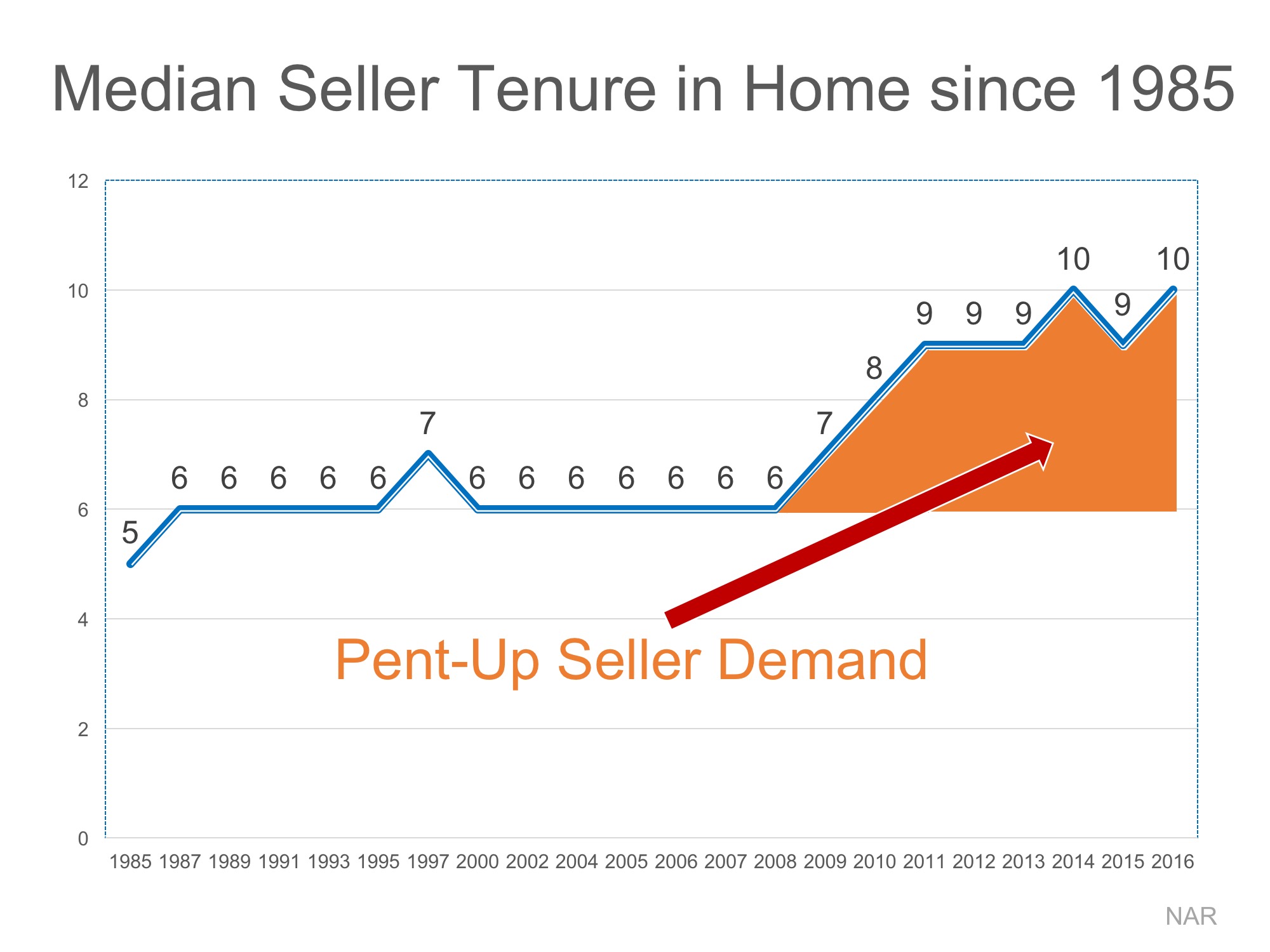
The National Association of Realtors (NAR) keeps historical data on many aspects of homeownership. One of the data points that has changed dramatically is the median tenure of a family in a home, meaning how long a family stays in a home prior to moving. As the graph below shows, for over twenty years (1985-2008), the median tenure averaged exactly six years. However, since 2008, that average is almost nine years – an increase of almost 50%.
How Long Do Most Families Stay in Their Home? | MyKCM

Why the dramatic increase?

The reasons for this change are plentiful!
The fall in home prices during the housing crisis left many homeowners in a negative equity situation (where their home was worth less than the mortgage on the property). Also, the uncertainty of the economy made some homeowners much more fiscally conservative about making a move.
With home prices rising dramatically over the last several years, 93.9% of homes with a mortgage are now in a positive equity situation with 78.8% of them having at least 20% equity, according to CoreLogic.
With the economy coming back and wages starting to increase, many homeowners are in a much better financial situation than they were just a few short years ago.
One other reason for the increase was brought to light by NAR in their 2017 Home Buyer and Seller Generational Trends Report. According to the report,
Sellers 36 years and younger stayed in their home for six years…”
These homeowners who are either looking for more space to accommodate their growing families or for better school districts are more likely to move more often (compared to 10 years for typical sellers in 2016). The homeownership rate among young families, however, has still not caught up to previous generations, resulting in the jump we have seen in median tenure!

What does this mean for housing?

Many believe that a large portion of homeowners are not in a house that is best for their current family circumstance; They could be baby boomers living in an empty, four-bedroom colonial, or a millennial couple living in a one-bedroom condo planning to start a family.
These homeowners are ready to make a move, and since a lack of housing inventory is still a major challenge in the current housing market, this could be great news.

Friday, June 10, 2016

I can't scream this loud enough "Sellers Market, Sellers Market, Sellers Market"

I can't scream this loud enough. If you are considering selling within the next 24 to 36 months Now is the time to Sell! Sellers Market, Sellers Market, Sellers Market


Bret
Wilson
Keller Williams
Flower Mound TX
(214) 315-9465
bret.wilson@kw.com

Wednesday, June 1, 2016

A Possible Housing Meltdown? These Experts Respectfully Disagree

A Possible Housing Meltdown? These Experts Respectfully Disagree | Simplifying The Market

A Possible Housing Meltdown? These Experts Respectfully Disagree

We want to let you know that “rumors of a new market meltdown” are not based on any reputable data. As proof, we offer you the comments of the following experts who have a totally different view on the current housing market.

Lawrence Yun, Chief Economist at NAR:

“In spite of deficient supply levels, stock market volatility and the paltry economic growth seen so far this year, the housing market did show resilience and had its best first quarter of existing-sales since 2007.”

Jonathan Smoke, Chief Economist at realtor.com:

“We had a triple crown of April home sales reports, so 2016 is in the pole position to earn best year of home sales in a decade.”

Andrea Riquier, MarketWatch housing reporter:

“I'm calling the end of the housing “recovery.” On to ‘expansion.’”

Freddie Mac:

“Despite the disappointing economic reports, we still forecast housing to maintain its momentum in 2016.”

Steven Russolillo, Wall Street Journal housing reporter:

“A recent gauge of home builder sentiment held firmly in positive territory, according to the National Association of Home Builders. Perhaps more important, expectations for sales in the next six months jumped to the highest level of the year.”

Fannie Mae:

“Our latest housing tracker shows that the first quarter of 2016 was the second fastest first quarter pace of home sales in the past decade... Home sales typically rise in the spring and summer months, and we anticipate an acceleration in home sales that will surpass 2007's pace by late summer.”

Thursday, May 19, 2016

The Presidential Election and Its Impact on Housing


The Presidential Election and Its Impact on Housing | Simplifying The Market

The Presidential Election and Its Impact on Housing


Every four years people question what effect the Presidential election might have on the national housing market. Let’s take a look at what is currently taking place. The New York Times ran an articleearlier this week where they explained:
“A growing body of research shows that during presidential election years — particularly ones like this when there is such uncertainty about the nation’s future — industry becomes almost paralyzed. A look at the last several dozen election cycles shows that during the final year of a presidential term, big corporate investments are routinely postponed, and big deals are put on the back burner.
The research is even more persuasive on the final year of an eight-year presidential term, when a new candidate inevitably will become president.”
We are seeing this take form in the latest economic numbers. However, will this lead to a slowdown in the housing market? Not according to Fannie MaeFreddie Mac or the National Association of Realtors.

The Impact on Housing Throughout 2016

Let’s look at what has happened and what is projected to happen by these three major entities.

National Association of Realtors

“In spite of deficient supply levels, stock market volatility and the paltry economic growth seen so far this year, the housing market did show resilience and had its best first quarter of existing-sales since 2007.”

Freddie Mac

“Recent data darkened the growth outlook for the first quarter of 2016. However, despite the disappointing economic reports, we still forecast housing to maintain its momentum in 2016.”

Fannie Mae

“Consumers and businesses showed caution at the end of the first quarter…(but) Home sales are expected to pick up heading into the spring season amid the backdrop of declining mortgage rates, rising pending home sales and purchase mortgage applications, and continued easing of lending standards on residential mortgage loans.”

Bottom Line

Even during this election year, the desire to achieve the American Dream is greater than the fear of uncertainty of the next presidency.

Questions about your home or market? You can contact me using the contact form at the top right of this blog.


Bret
Wilson
Keller Williams
Flower Mound TX
(214) 315-9465
bret.wilson@kw.com

Tuesday, May 17, 2016

7 Out of 50 Homeowners Could Save Money

7 Out of 50 Could Save Money - 5/16/2016 

It is estimated that seven million out of 50 million homeowners could save money by refinancing their existing mortgages. Obviously, if the replacement mortgage has a lower rate than your existing one, you will save money.

If you bought a home before 2011 and are paying mortgage insurance, you should investigate refinancing to eliminate that requirement. Even if you don’t get a lower interest rate, the savings could amount to hundreds of dollars a month.

If a home you purchased since 2011 has appreciated enough, it could easily justify refinancing to eliminate the required mortgage insurance. Most loans don’t require mortgage insurance if the loan-to-value is 80% or less. There are some programs for 90% mortgages that don’t require mortgage insurance. It is certainly worth investigating with a trusted mortgage professional.

Continuing to pay mortgage insurance that could be eliminated is like having a broken cell phone and continuing to make the monthly payments for something you can’t use and don’t need.

If your current mortgage is several years old, instead of getting a new 30 year mortgage, you might consider a 15-year term. The money you save with a lower interest rate could help you to retire your loan in a shorter time so that your home would be paid for.
30-year average FRM.png
Looking for a lender? I know a few reputable hard working lenders and would be happy to send you their information. You can contact me using the contact form at the top right of this blog.


Bret
Wilson
Keller Williams
Flower Mound TX
(214) 315-9465
bret.wilson@kw.com

Tuesday, May 10, 2016

You may never stop paying for some improvements

You may never stop paying for some improvements - 

14041766_s.jpgYou've saved the money and are ready to pay cash to build a new pool for your home.  However, that's just the beginning of your soon to be increased expenses which will include maintenance, higher utilities and higher taxes.
Homeowners obviously benefit by a larger equity when their home increases in value due to appreciation.   A not-so-obvious effect that will also more than likely take place is that their property taxes will increase.  In most cases, a property's assessed value is generally tied to market value to calculate the property taxes based on the tax rate for that year.
Similarly, a homeowner can affect the value of their home by making capital improvements.  Some small items may never be recognized by the taxing authority but items that require a permit, certainly are brought to their attention.  Items such as a fence, roof, remodeling, windows, new rooms or swimming pools can easily increase the assessed value of a property.
Most states have an established time frame in which to challenge the current tax assessment for that year.  The process is relatively simple and doesn't require professional representation.  It generally involves showing that there is an error which has overstated the value or that current comparable sales indicate a lower value.
If you'd like more information or need the comparable sales data, please let us know.  We would be happy to help you investigate the possibility of lowering your property taxes.

Tuesday, May 3, 2016

Your home may be worth a lot more than you think


Real estate lost a lot of value during the recession but most areas have rebounded considerably.  In some cases, the homes are worth more than they were before the housing bubble burst.60178926_250.jpg
The dynamics are classic for this type of market: inventories are low, mortgage rates are low and demand is high.  All price ranges are on the rise with some at an even higher rate because the short supply is causing competition among buyers.

Another reason many homeowners' may have more equity is simply not staying current with what is going on in the market.  In a recent FNMA study, it indicates that 23% of owners believe they have negative equity in their home when actually, it is 9%.  37% believe they have greater than 20% equity in their home when actually 69% of homeowners do.

Even if you're not planning to sell your home, knowing the value helps you understand your financial position better.  The interest on home equity debt up to a $100,000 limit is tax deductible and can be used for any purpose.  Owner's commonly refinance to eliminate mortgage insurance, consolidate mortgages, pay off higher interest rate debt like credit cards or student loans or to buy out an ex-spouse's equity.

Be aware that an automated value model like Zillow Zestimates uses algorithms to determine a price and while it might be in the ballpark, AVM results may only be accurate about 20% of the time.  A comparable marketing analysis or broker's price opinion will be more accurate due the subjective approach that will be used by an agent with personal experience in the area.  An agent will consider factors like condition, floorplan, marketability and demand.

You can create your own report of Current Active and sold homes in your area here!

For a professional opinion or questions contact me @ bret.wilson@kw.com or 214-315-9465 

Monday, December 7, 2015

NAR Reports Reveal Two Reasons to Sell This Winter

NAR Reports Reveal Two Reasons to Sell This Winter | Simplifying The Market

NAR Reports Reveal Two Reasons to Sell This Winter

We all realize that the best time to sell anything is when demand is high and the supply of that item is limited. The last two major reports issued by the National Association of Realtors (NAR) revealed information that suggests that now is a great time to sell your house.
Let’s look at the data covered by the latest Pending Home Sales Report and Existing Home Sales Report.

THE PENDING HOME SALES REPORT

The report announced that pending home sales (homes going into contract) are up 3.9% over last year, and have increased year-over-year now for 14 consecutive months.
Lawrence Yun, NAR’s Chief Economist, expects demand to remain stable through the final two months of the year, and “forecasts existing-home sales to finish 2015 at a pace of 5.30 million – the highest since 2006.” 
Takeaway: Demand for housing will continue throughout the end of 2015 and into 2016. The seasonal slowdown often felt in the winter months hasn’t started and shows little signs of being near.

THE EXISTING HOME SALES REPORT

The most important data point revealed in the report was not sales but instead the inventory of homes on the market (supply). The report explained:
  • Total housing inventory decreased 2.3% to 2.14 million homes available for sale
  • That represents a 4.8-month supply at the current sales pace
  • Unsold inventory is 4.5% lower than a year ago
There were two more interesting comments made by Yun in the report:
1. "New and existing-home supply has struggled to improve, leading to few choices for buyers and no easement of the ongoing affordability concerns still prevalent in some markets."
In real estate, there is a guideline that often applies. When there is less than 6 months inventory available, we are in a sellers’ market and we will see appreciation. Between 6-7 months is a neutral market where prices will increase at the rate of inflation. More than 7 months inventory means we are in a buyers’ market and should expect depreciation in home values. As Yun notes, we are currently in a sellers’ market (prices still increasing).
2. "Unless sizeable supply gains occur for new and existing homes, prices and rents will continue to exceed wages into next year and hamstring a large pool of potential buyers trying to buy a home.” As rents and prices increase, potential buyers will not able to save as much for a down payment and many may become priced out of the market.
Takeaway: Inventory of homes for sale is still well below the 6 months needed for a normal market. Prices will continue to rise if a ‘sizeable’ supply does not enter the market. Take advantage of the ready willing and able buyers that are still out looking for your house.

Bottom Line

If you are going to sell, now may be the time.

Wednesday, November 4, 2015

Price is Important When Selling your Home

House Hasn’t Sold Yet? Take Another Look at the Price | Simplifying The Market

House Hasn’t Sold Yet? Take Another Look at the Price

The residential housing market has been hot. Home sales have bounced back solidly and are now at their second highest pace since February 2007. Demand remains strong going into the winter. Many real estate professionals are reporting that multiple offers are occurring regularly and listings are actually selling above listing price. What about your house?

If your house hasn’t sold, it is probably the price.

If your home is on the market and you are not receiving any offers, look at your price. Pricing your home just 10% above market value dramatically cuts the number of prospective buyers that will even see your house. (See Chart)
Proper Pricing Pyramid | Simplifying The Market

Bottom Line

The housing market is hot. If you are not seeing results you want, sit down with your agent and revisit the pricing conversation.