Showing posts with label Listing your home. Show all posts

Tuesday, December 22, 2020

When Listing your Home "For Sale" is Staging Required?

Staging your home can be a great way to increase your profits and/or reduce your time on the market. How do you know if staging is right for you? 


Probate Information about Real Estate Real Estate Probate Information

Free tool for determining the value of your home?   What is my Homes Value?

Other Free tools for your Home Search or Sale Other Free Tools  

Free information, How to Sell your home? Listing and Marketing Guide

Have a question? Reply to this post or contact me here Contact me Here


PSA (Pricing Strategy Advisor),  CPRES (Certified Probate Real Estate Specialist)

Texas Real Estate Commission Information About Brokerage Services

Texas Real Estate Commission Consumer Protection Notice

Thursday, April 11, 2019

18 Important Points of Negotiation of a Home Purchase Offer in Texas


18 important points of negotiation when making or receiving an offer on a Single-Family Home in Texas


Negotiating an offer to purchase or sell a home is much more complex than most consumers recognize. Below I have listed 18 opportunities for negotiation on the Standard TREC 1 to 4 Family Residential Resale Contract. Not fully understanding each point of negotiation and how they affect the overall closing of the transaction could cost you Time, Money or the Sale or Purchase of your home altogether


1.       Improvements (Line - 2 D. of Contract) – Are there items such as TV mounts, antique lighting fixtures, specialty doors or any other fixture that the seller intends to take with them when they move? Will the seller replace the removed items with new acceptable items before they move?

2.       Mineral Rights (Line - 2 E. of Contract) – Does the seller still own the mineral rights to the property? Will the mineral rights convey to the new buyer or stay with the seller? (Addendum would be required if the seller wishes to maintain mineral rights)

3.       Sales Price (Line - 3 of Contract) – What is the total purchase price? How much down payment will the buyer provide? How much in financing will the buyer require? (Addendum would be required if the buyer is using financing)

4.       Earnest Money Deposited (Line 5 of Contract) – How much earnest money will the buyer deposit with the title company?

5.       Title Company Used (Line 5 of Contract) – What title company will be used to close the transaction?

6.       Title Policy (Line 6 A. of Contract) – What title company will provide the title policy? What type of tile policies will be provided? Who will pay for the title policies “Buyer or Seller”?

7.       Survey (Line 6 C. of Contract) – Can an existing survey be used to close this transaction? If not, who will pay for the new survey?

8.       Title Objections (Line 6 D. of Contract) – How many days will the buyer have to review the title disclosure? What prohibited use or activities will be included as possible objections?

9.       HOA Documentation (Line 6 E. 2 of Contract) – Is the home being sold subject to mandatory membership in an HOA? If so, will the HOA addendum be used as part of this contract?

10.     Sellers Disclosure (Line 7 B. of Contract) – Is a seller’s disclosure required? If so when will the seller's disclosure be provided to the buyer?

11.   Upfront Repairs (Line 7 D. of Contract) – Is buyer requesting upfront repairs or treatments even before the inspection is complete?

12.   Home Warranty (Line 7 H. of Contract) – Will the seller contribute funds to purchase buyer home warranty?

13.   Closing Date (Line 9 A. of Contract) – What date will buyer and seller close on the home?

14.   Buyer Take Possession (Line 10 A. of Contract) – When will the buyer take possession of the home? If buyer or seller need a temporary lease an (Addendum would be required)

15.   Special Provisions (Line 11 of Contract) – Is there a detail that needs to be added in Special Provisions, applicable to the specific offer at hand, that TREC has not promulgated a form, lease or addendum for?

16.   Seller Paid Closing Cost (Line 12 A. of Contract) – Will the seller contribute funds on behalf of the buyer to help pay for the buyer's cost of closing on the home?

17.   Addenda to Contract (Line 22 of Contract) – What Addenda are being used with this specific transaction? Many Addenda are required by law or being used as best practice for the buyer or seller.


18.   Option Period (Line 23 of Contract) – Will the buyer have an unrestricted right to terminate the contract? (Typically used to have the home inspected) If so, how long will the option period last? How much will the buyer pay the seller for the option period? 
.


Would you Like to know How Much homes are selling for in your Neighborhood?   Whats My North Texas Homes Value

See current homes For Sale here  Free Home Search App

Have a question? Reply to this post or contact me here Contact Me Here


Tuesday, December 18, 2018

How is the Market? We need more information to answer that question

Less than $250K $251K to $400K Over $400K

Starter homes are still in a very strong sellers market. Homes that are listed under $250,000 in the DFW are continuing to sell in about 20 days with less than 2 months supply available. Homes selling between $250,000 and $400,000 are in a moderate sellers market with a current available supply of 3.2 months and selling in just under 30 days. Homes priced over $400,000 are leveling out to a more even market and selling in just over 50 days with 5.5 months supply.A important step in listing your home is knowing the market condition. Don't assume every home in DFW is experiencing the same conditions. When you are ready to determine the perfect plan for your home and situation, give me a call.

Subscribe to and view the complete Housing Trends Newsletter Here  Housing Trends News Letter

See How Much homes are selling for in your Neighborhood?   Whats My North Texas Homes Value

See current homes For Sale here  Free Home Search App

Have a question? Reply to this post or contact me here Contact Me Here


Wednesday, December 5, 2018

Tuesday, November 20, 2018

Thursday, November 15, 2018

Need to sell your home and cant complete repairs? No worries!

Are you considering selling your home as is? Are you attracted to a no hassle selling process? I can help you sell your home with a plan that works for you.  


Subscribe to and view the complete Housing Trends Newsletter Here  Housing Trends News Letter

See How Much homes are selling for in your Neighborhood?   Whats My North Texas Homes Value

See current homes For Sale here  Free Home Search App

Have a question? Reply to this post or contact me here Contact Me Here


Tuesday, October 16, 2018

6 Home Renovation Myths to Stop Believing Before You Botch Things Up


Click on photo to see renovations


Subscribe to and view the complete Housing Trends Newsletter Here  Housing Trends News Letter

See How Much homes are selling for in your Neighborhood?   Whats My North Texas Homes Value

See current homes For Sale here  Free Home Search App

Have a question? Reply to this post or contact me here Contact Me Here


Friday, March 9, 2018

The North Texas Market is Still Hot

This Gorgeous Arlington Listing Sold this week. We received a full price offer and in contract in 8 Days. Congratulations!


I can help you list your home as well.  Reply to this post or contact me here Contact Me Here


Wednesday, August 16, 2017

Sellers: Your Home is an Oasis in an Inventory Desert


Sellers: Your Home is an Oasis in an Inventory Desert


First-time homebuyers are flocking to the real estate market by the thousands to find their dream homes in order to make their dreams of homeownership a reality. Unfortunately for many, the inventory of starter and trade-up homes in the US has struggled to keep up with demand!
According to the National Association of Realtors (NAR), the inventory of homes for sale dropped 7.1% year-over-year to a 4.3-month supply and is down for the 25th consecutive month.
Some homeowners may be hesitant to list their homes for sale because they are worried that they will also have a problem finding a home to buy and move in to. This is a legitimate concern; no one wants to sell their home quickly and not have anywhere to live.
But there is good news! If you are thinking of moving up to a luxury or premium home, there is more inventory available in these markets and you may even get a great deal on a home that has been on the market for a while.
If you are the owner of a starter home and you are looking to move into a trade-up home, or if you are just looking to relocate to a new area in a home of the same size, there is still hope!
In many markets, homeowners are building contingency plans into their contracts. This means that the homeowner builds in extra time before they close in order to find their dream home and they are upfront about the contingency with any buyers who come to see the house.
Your home is an oasis to buyers who are searching for homes in today’s market. The right buyers will sympathize and wait for you and your family to find your next home.

Bottom Line

Don’t let the fear of not finding a home to move in to stop you from moving on with your life. Let’s get together to discuss ways to set expectations with potential buyers from the start.


Thursday, August 10, 2017

How Long Do Most Families Stay in Their Home?


How Long Do Most Families Stay in Their Home?

How Long Do Most Families Stay in Their Home? | MyKCM
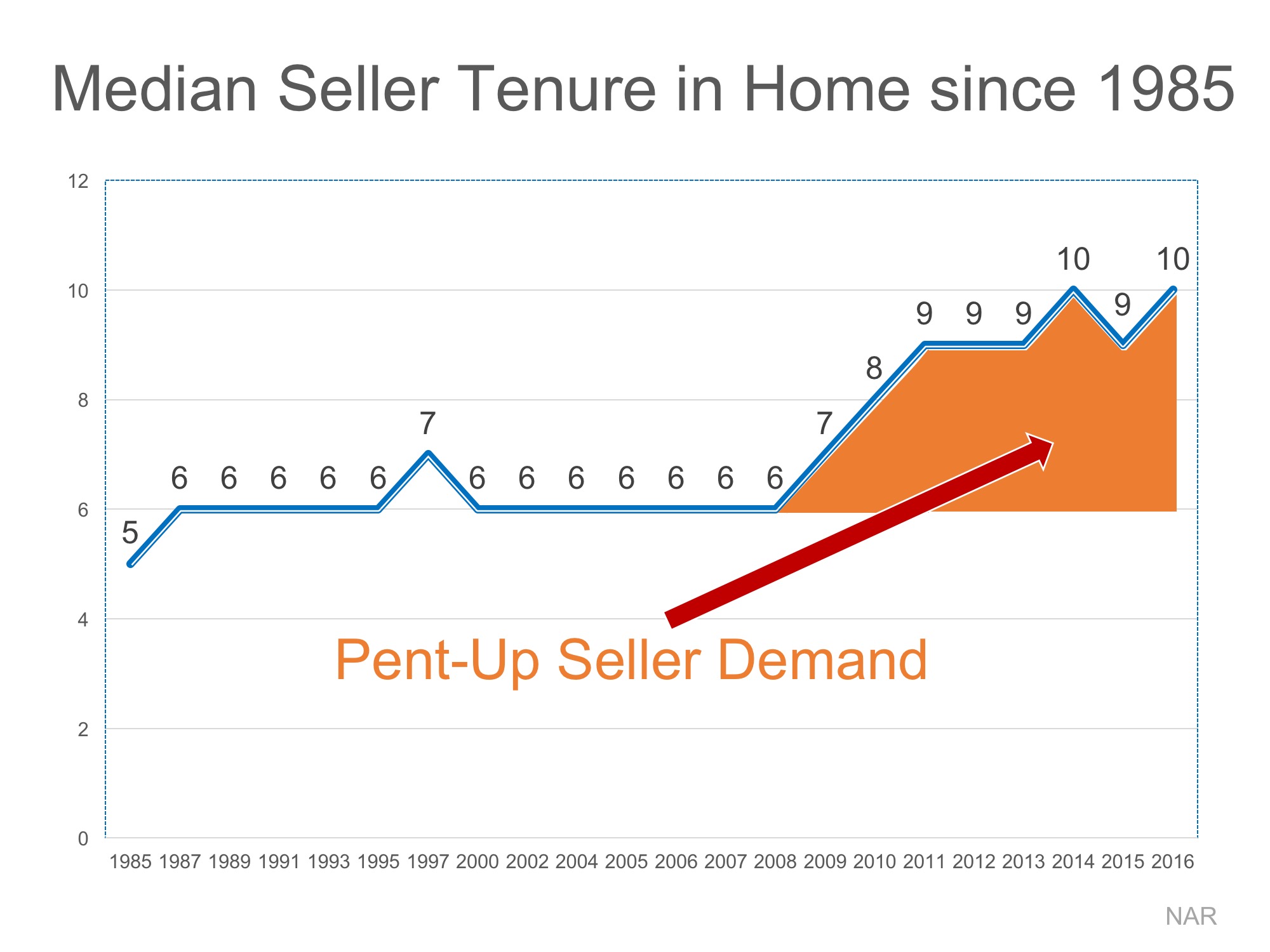
The National Association of Realtors (NAR) keeps historical data on many aspects of homeownership. One of the data points that has changed dramatically is the median tenure of a family in a home, meaning how long a family stays in a home prior to moving. As the graph below shows, for over twenty years (1985-2008), the median tenure averaged exactly six years. However, since 2008, that average is almost nine years – an increase of almost 50%.
How Long Do Most Families Stay in Their Home? | MyKCM

Why the dramatic increase?

The reasons for this change are plentiful!
The fall in home prices during the housing crisis left many homeowners in a negative equity situation (where their home was worth less than the mortgage on the property). Also, the uncertainty of the economy made some homeowners much more fiscally conservative about making a move.
With home prices rising dramatically over the last several years, 93.9% of homes with a mortgage are now in a positive equity situation with 78.8% of them having at least 20% equity, according to CoreLogic.
With the economy coming back and wages starting to increase, many homeowners are in a much better financial situation than they were just a few short years ago.
One other reason for the increase was brought to light by NAR in their 2017 Home Buyer and Seller Generational Trends Report. According to the report,
Sellers 36 years and younger stayed in their home for six years…”
These homeowners who are either looking for more space to accommodate their growing families or for better school districts are more likely to move more often (compared to 10 years for typical sellers in 2016). The homeownership rate among young families, however, has still not caught up to previous generations, resulting in the jump we have seen in median tenure!

What does this mean for housing?

Many believe that a large portion of homeowners are not in a house that is best for their current family circumstance; They could be baby boomers living in an empty, four-bedroom colonial, or a millennial couple living in a one-bedroom condo planning to start a family.
These homeowners are ready to make a move, and since a lack of housing inventory is still a major challenge in the current housing market, this could be great news.

Monday, January 23, 2017

Boomers Are Staying In-Place


There seems to have been an accepted progression for homeowners going from starter home, to gradually moving into one’s dream home, then, downsizing after becoming an empty nester and finally, into a retirement home. However, Marianne Cusato’s 2016 Aging-in-Place Report indicates that many older Americans don’t plan on following that pattern.
46668033-250.jpg
61% of homeowners above the age of 55 intend on staying in their homes indefinitely. 2/3 of them believe that the home’s layout will serve their needs without having to make aging-related improvements.
Some of the reasons being cited for staying in place are:
  • 66% say their home is conveniently located
  • 38% say they live close to their family
  • 68% say they feel independent in their home
  • 54% say they are familiar with their neighborhood
  • 66% say the feel safe in their home
Typical renovations that might be considered for their current home are things like grab bars in the tub or shower, shower seats, taller toilets, handheld showerheads and additional handrails on stairways.
It seems that the report’s conclusion is that regardless of a homeowner’s age, they want to thrive in their home. The same emotional reasons that causes a person to want to buy a home are the things that cause them to hold onto them if is practical.

Friday, January 20, 2017

Tips for Preparing Your Home For Sale

Tips for Preparing Your House For Sale 

Tips for Preparing Your House For Sale [INFOGRAPHIC] | Simplifying The Market

Highlights:

  • When listing your house for sale your top goal will be to get the home sold for the best price possible!
  • There are many small projects that you can do to ensure this happens!
  • Your real estate agent will have a list of specific suggestions for getting your house ready for market and is a great resource for finding local contractors who can help

Monday, December 5, 2016

Time May Be Running Out


During the Great Recession, some homeowners elected to rent their home rather than sell it for less than it was worth.
IRS tax code allows for a temporary rental of a principal residence without losing the exclusion of capital gain based on some specific time limits. During the five year period ending on the date of the sale, the taxpayer must have:
14095450-250.jpg
  • Owned the home for at least two years
  • Lived in the home as their main home for at least two years
  • Ownership and use do not have to be continuous nor occur at the same time
If a home has been rented for more than three years, the owner  will not have lived in it for two of the last five years. So the challenge for homeowners with gain in a rented principal residence that they don’t want to have to recognize is to sell and close the transaction prior to the crucial date.
Assume a person was selling a property which had been rented for 2 ½ years but had previously been their home for over two years. To qualify for the exclusion of capital gain, the home needs to be ready to sell, priced correctly, sold and closed within six months.
All of the gain may not qualify for the exclusion if depreciation has been taken for the period that it was rented. Depreciation is recaptured at a 25% tax rate.
A $200,000 gain in a home could have a $30,000 tax liability. Minimizing or eliminating unnecessary taxes is a legitimate concern and timing is important.
Selling a home for the most money is one thing; maximizing your proceeds is another. For more information, see IRS publication 523 and an example on the IRS website and consult a tax professional. 

Thursday, November 3, 2016

Tuesday, September 6, 2016

Getting to Property Value

Getting to Value

Fair market value is the price that real estate would sell for on the open market without any unusual forces being involved. The definition is relatively simple but there certainly different methods of determining what it is.
27939218-250.jpg
A homeowner could order an appraisal before they put their home on the market but would incur the expense of an appraisal and more likely than not, it won’t or can’t be used by the buyer or their lender. The advantage is that an appraisal is a professional approach by a disinterested party to establish value.
Licensed appraisers use three approaches to value: the market data, the replacement cost and the income approach. The appraiser can put more weight on one approach than another based on his/her assessment of what would be appropriate.
The replacement cost looks at what it would cost to rebuild the property today less the depreciation it has experienced by age and wear and tear plus the value of the lot.
The income approach uses a capitalization rate based on the net operating income of a property to determine value. It is more applicable to commercial properties than it is for homes used by homeowners and not rented.
The market data approach relies on recent sales of similar properties near the subject. The appraiser will make monetary adjustments for differences in the comparables that are used to create a more accurate comparison.
Real estate agents use a similar approach to determine fair market value by performing a Competitive Market Analysis, CMA. Like the market data approach of an appraisal, it looks at recent sales of similar properties, it also considers properties currently for sale and what homes were unsuccessful in their attempt to sell. This approach is sensitive to supply and demand and may be more reactive to rapidly rising or declining markets.
Both appraisals and CMAs have a distinct advantage because of the personal opinion as a professional compared to online website estimates using raw data and mathematical formulas. Regardless of which method is used, it is an estimate. Obviously, some estimates are more accurate based on the experience of the person making the estimate. A price is placed on the property by the seller but value is ultimately determined by the buyer when a final sale is achieved.